Come in. You don't have to say anything.
You touch the dot and speak — even a fragment. Or you write, if you prefer. Ondela writes it down, tidies it and most of the time answers nothing. It does not judge, does not diagnose and is not therapy. There is no company behind it; I don't read entries — below I write exactly what I can and can't see.
The app is running; I let people in one at a time. You can leave your address at the end — or not at all.— Damian
The app itself is in Polish for now — this page is here so you know what you'd be waiting for.

I don't know what brought you here. I'll guess three things.
Maybe you don't know where to start — and it feels like it isn't “that” serious. A fragment of a sentence is enough — spoken, or written if you prefer. It does not have to be serious, and it does not have to be tidy. You can also do nothing and come back in a week, or a month. Nobody counts the days and there is no streak to keep up.
Maybe someone once heard you badly. Nobody here will tell you who you are. What Ondela writes about you in the Portrait is a hypothesis with its source shown: under each one lie your own words it came from. You can confirm it, correct it, write in your own words why not — or delete it. If you reject a proposal, mark one “that's not it” or delete an observation, Ondela does not propose it to the Portrait again for 30 days.
Maybe you count every penny. An hour with someone who can do this is a sum every week; a free waiting list is measured in months. Today speaking, the Journal, the Portrait and the Echo cost nothing. Conversations and meditations are the paid part: the cost in credits is fixed and taken at the start, never mid-way — for the longer conversation and a meditation from the catalogue you see it beside the button — and you start with a pool without paying. Maybe you are waiting for an appointment, maybe it is already in your calendar. What you say here will be waiting in your phone — and you walk in with it, instead of starting from “I don't know where to begin”. Stay in that queue.
If you have someone who listens well — this is not instead. If this isn't about you — that's fine too. Look around anyway.
What happens when you say something
The most common path is no path at all: you speak, then get on with your day. The rest happens without you and waits until you feel like looking.
- Now
You touch the dot and talk for two minutes about what happened. You do not think about the wording. The entry is transcribed and kept in full. Usually nothing answers you — and that is the point.
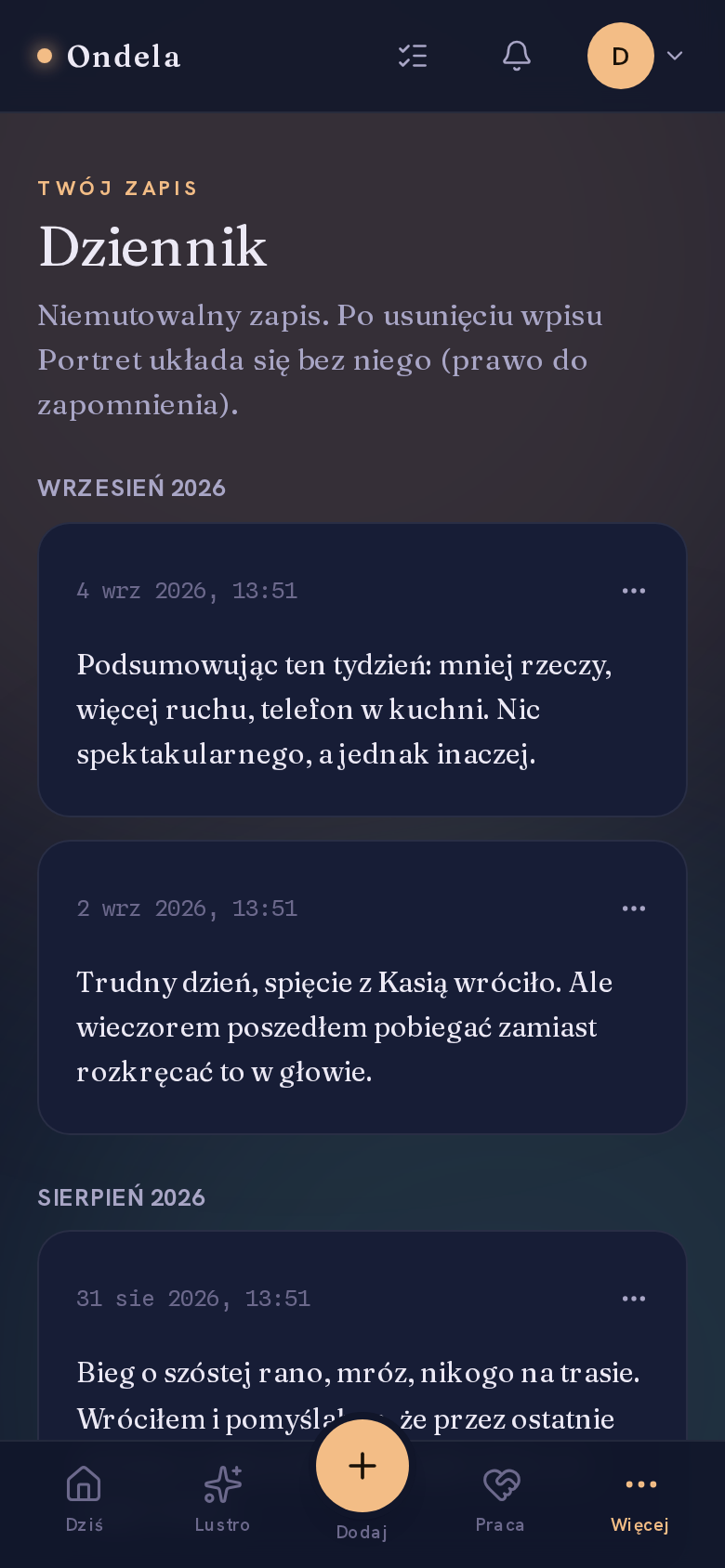
A screen from the demo account — nobody's real entries. - — usually nothing happens here —
- When you look in
When you look in and there is something to draw on, you find a short Echo of the day — it grows with each new entry. And when you ask for a look at the whole week — whatever keeps repeating.
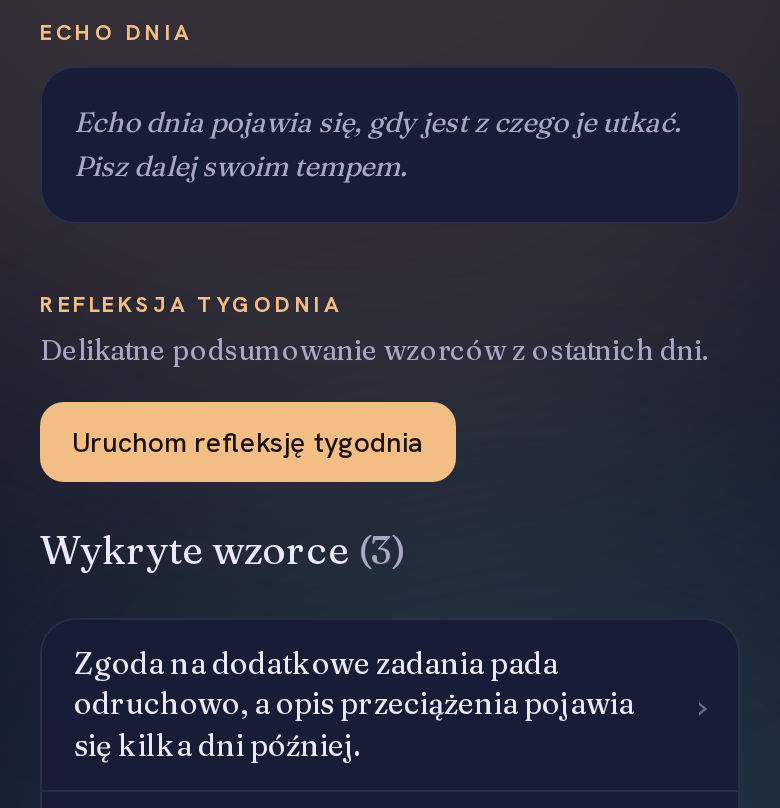
A screen from the demo account — nobody's real entries. - After a few weeks
After a few weeks a paragraph appears in the Portrait of the kind nobody writes about themselves. Under it, the observations it follows from, and under each of those your own words — quotes from entries or conversations, with a link. Every observation you confirm, correct, comment on or delete; a change made automatically you undo with one click. And you can stay here — with a journal that is usually silent.
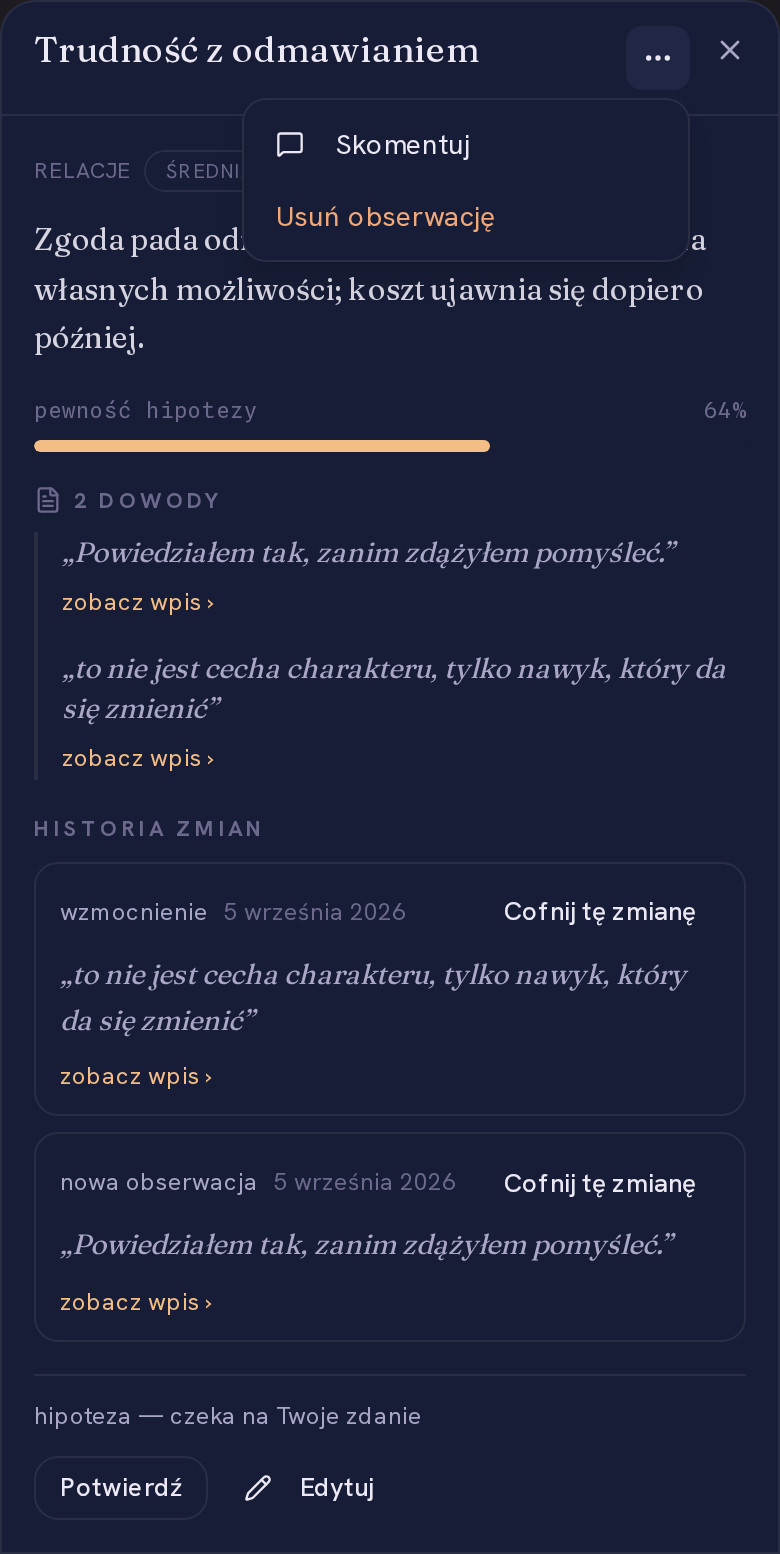
A screen from the demo account — nobody's real entries. - When you want more
There are also rooms you never have to enter: conversations — a longer one with the guide, or a short one hooked to a single entry — and meditations woven from whatever you have been carrying lately. You enter only when you ask to. The guide is a role, not a character. These are the only things that cost credits — a pool you get up front, not a subscription.
How deep conversations go is your setting. It is a ceiling Ondela can only lower, never raise: over the first entries it stays shallower, and on a crisis signal it does not start the conversation at all — it shows the helpline numbers instead.
Subjects marked as confidential do not surface on their own: the Echo can at most mirror them and never steers towards them; the short conversation and meditations do not reach for them at all; and any change to such an observation is yours to approve. The exception is the longer conversation with the guide — there you bring the subject, so the guide sees the whole Portrait, the confidential parts included. Which subjects those are, you set on each observation.


What isn't here.
Streaks or guilt bars.
About entries — never. There is no “you haven't written in three days”. If anything ever does reach you, it will be a single invitation to look, one you can ignore — not a reproach.
A reply to every entry.
The first 3 entries get no Echo (unless it is a crisis — then, instead of an Echo, there is a short message and the helpline numbers). Afterwards usually none either: a fixed rule with a high bar decides; the model only supplies the signals.
Judgements or diagnoses.
“It looks as if…”, never “you are the kind of person who…”. In conversations a separate gate checks every reply for the language of diagnosis; in the Echo and the Portrait the model's instructions guard it — and so does your button to delete an observation.
A character that misses you.
Ondela does not pretend to be a person: it does not miss you, it does not ask where you have been. When you close the app, nobody comes after you.
Therapy.
Ondela starts by listening; when you ask, it draws on techniques known from cognitive-behavioural work, mindfulness and Stoicism — the way a running app draws on physiology without being a doctor. It does not diagnose, does not treat, and does not replace a person who can. But it can be what you do beforehand: after a few weeks you have your own words, your own examples and the things that keep coming back. You walk into the consulting room with that, instead of starting from “I don't know where to begin”. And if you already have someone good — this is not instead.
A place for anyone under 18.
Ondela is for adults. If you are younger — in Poland there is a free helpline for young people, 116 111, and someone there will actually pick up.
Anyone who reads entries as part of a job.
There is no team and no moderation. There is also no human who would read it at night — better to have that clear from the start. What there is, is a place that takes everything at that hour and is still there in the morning.
A price list — yet.
Today speaking, the Journal, the Echo and the Portrait cost nothing. Conversations and meditations draw on a pool of credits you get up front — not a subscription; the starting pool covers a few conversations and one meditation without paying. For the longer conversation and for a meditation from the catalogue the cost in credits sits beside the button before anything starts; the short conversation and the breathing moment offered after an entry come out of the same pool. There is no price in money yet. I want what is free today to stay free. How much the rest will cost, I am still working out. The price list will appear on this page before anyone pays — and so will any change to what is free.
A newsletter.
Your e-mail address is used for three things: a confirmation when you leave it, an invitation when there is room, and a sign-in link when you ask for one. There is no newsletter. Nor any analytics that I would have added myself.
When it is really bad.
An ordinary hard day — sadness, anger, crying, “I can't cope” — is still an ordinary journal: it is saved and usually nothing replies. But if you say something that sounds like a threat to your life, Ondela tries to recognise it and does less, not more: the entry stays in your Journal, flagged, but goes no further — not to the Portrait, not to the Echo, not to any offer. Instead of an Echo it shows a short message and the numbers of people who can help right now. The app itself does not call anyone and does not notify anyone. It is a program and it can be wrong — so take this number with you regardless of the app: in Poland 116 123, free of charge; when life is in danger, 112. The numbers in the app are Polish — outside Poland, call your local emergency number.
Who opens the door
My name is Damian. There is no company and no investor behind Ondela — the decisions are mine, and it is me who answers the mail. I am not a therapist and I am not trying to be one. By trade I'm a programmer, but what drives me most is an interest in self-development and wanting to help people — that's where Ondela comes from. The name sounds like a first name, but it is nobody's — on purpose.
I know what Ondela is today. Where it goes also depends on what people do with it.
What I can see, and what I can't. Your entries are encrypted with a separate key for each account and sit on a server in the Netherlands. The recording is not kept after transcription — unless you turn that on.
I train nothing on your entries. I don't read entries. Technically I could — I hold the master key — and I would rather tell you that than write “nobody can”; if you ever ask for help with a specific entry and I have to look at it, I will tell you so outright.
Delete an entry and it is gone from the Journal, the Portrait, the day's Echo and the weekly summary, together with the quotes taken from it. A conversation or a meditation that has already grown from it stays until you delete it. There is no “delete account” button yet. Write to me and I will delete everything. The full text about data, including what isn't there yet →
If it costs nothing — who pays? I do. That is why I let people in a few at a time — so I can write back to each of them when something does not work. Conversations and meditations will cost something, because they cost me: each one is a paid request to a model. There is no amount in money yet — and I don't want that amount to decide whether you come in.
Write if something does not work, if you want off the list, or if you have a question about data: kontakt@ondela.me. I answer myself, usually within a few days. If things are really bad right now, this mailbox will not help — your local emergency number will; in Poland, 116 123.
A spare key
The app is running, but I let people in one at a time. Leave your address. You will get two e-mails from me: a confirmation now and an invitation when there is room. Nothing else will come.
What happens to the address: it goes into Ondela's database (a server in the Netherlands) as an account that is waiting. The data controller is Damian Malinowski. Contact: kontakt@ondela.me. The address is used for two messages now — the confirmation and the invitation — and, once the account is active, to sign in: a one-time link comes only when you ask for it. They are sent by Resend (a company in the USA). Legal basis: your request for a place. I keep it for as long as the account is waiting or in use; write to me and I will delete it. The IP address the request comes from is kept for a quarter of an hour to limit how much mail goes out — then it is gone. You have the right to access, correct and erase it, to restrict its processing, to take it with you and to object — and to lodge a complaint with the Polish supervisory authority (the President of UODO). By leaving the address you confirm that you are 18 or older. No newsletter, and no analytics I would have added myself.
Thanks. It helps me decide who to let in first.Done. The confirmation should be in your inbox — check the spam folder too. Until then — silence.That does not look like an e-mail address.A request from this address or this network already went out in the last few minutes. If there is no confirmation in your inbox (check spam too), try again in a few minutes — the address is still in the field.Something did not work on my side. Try again in a moment — the address is still in the field.- Ondela runs in your phone's browser — you add it to the home screen like an app; there is no store.
- The account is just an e-mail address, any address; you give nothing else.
- The app can be locked with a fingerprint, so nobody holding your phone can open it.
Beyond that confirmation and one invitation, nothing else will come.